Email still gives cybercriminals the easiest path into business. Many clients deal with phishing attempts, fake invoices, and impersonation every day. These attacks slow their teams, damage trust, and often cost real money. MSPs see this play out constantly as clients ask, “Is this email real?” For small businesses with limited security maturity, the risks stack up fast.
Because of this growing pressure, SMB1001 introduced a major shift. The 2026 update now requires DMARC and stronger email authentication controls. This change marks one of the most significant updates since the standard launched. It brings SMB1001 in line with modern cybersecurity standards and creates a new baseline for SMB1001 DMARC compliance. MSPs, resellers, and partners across Australia will feel the impact.
At Bluechip IT, we help partners understand these changes and adapt early. In this update, we explore what changed, why SMB1001 email authentication now matters, and how this shift affects your customers. By the end, you’ll see why this new requirement plays a major role in reducing risk and supporting stronger service outcomes.

Understanding SMB1001 and Why It Matters
Dynamic Standards International, the team behind SMB1001, built the framework to guide smaller organisations toward practical and achievable security maturity. Many global cybersecurity standards can overwhelm SMBs. SMB1001 avoids that by offering a clear and structured pathway.
Until now, SMB1001 encouraged email authentication but has not required it. The 2026 update changes that approach. The new version introduces smb1001 email authentication into Levels 2 and 3. This shift shows how critical identity protection has become for Australian businesses.
SMBs face rising threats each year. Attackers now target unsecured domains more often because these weaknesses remain easy to exploit. SMB1001 needed clearer guidance, and DMARC provides that direction.
What Changed in SMB1001:2026?
The most important update is the addition of Email Authentication and Anti-Spoofing controls. These appear at Level 2 and strengthen at Level 3. DSI made this change because email attacks continue to rank among the most common and damaging threats for SMBs. Many partners now refer to this update as SMB1001 2026 DMARC due to its industry-wide impact.
The ACSC Annual Cyber Threat Report 2024–25 highlights this trend. Email compromise and identity-based attacks remain among the top incidents reported by Australian businesses. The financial impact also continues to rise.
This aligns with what MSPs already see. Most attacks bypass complex defences and succeed through simple deception.
To address that risk, SMB1001:2026 now requires:
- Valid SPF records
- DKIM signing with strong keys
- A published DMARC record with reporting enabled
- A DMARC policy set to quarantine or reject
- Alignment across SPF, DKIM, and DMARC
These controls work together to confirm whether an email comes from a legitimate domain. They also prevent unauthorised messages from reaching the inbox. As a result, email security becomes a core compliance requirement rather than an optional best practice.
Why DMARC Is Essential for Risk Management
DMARC continues to play a central role in protecting SMBs from phishing and spoofing attacks. Without it, attackers can easily send emails that look like they come from your client’s domain. Many use this tactic to steal money, trick staff, or impersonate suppliers.
When businesses enforce DMARC, their domains become far harder to misuse. Mail servers can verify legitimate senders before accepting messages. If something fails validation, the server blocks or quarantines it. This adds a strong layer of protection that runs quietly in the background.
DMARC also improves email deliverability. Many SMBs deal with messages landing in spam or failing to reach clients. A valid DMARC policy signals trust to receiving servers, which helps improve inbox placement.
This trend is not limited to SMB1001. Major email providers like Google and Microsoft now enforce stricter authentication rules. Government bodies and industry groups also expect stronger identity controls. The SMB1001 update aligns with these global expectations and reinforces the growing need for SMB1001 DMARC compliance.
What This Means for MSPs, Resellers, and Partners
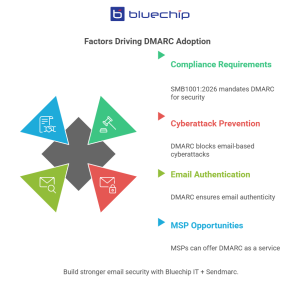
This update may feel like another compliance task, yet it also creates a clear opportunity. Many SMBs still don’t understand what DMARC does or why their domain setup matters. They rely on their MSP to explain the risks and guide them through each step.
Here’s what this update means:
Higher demand for email security services
Most SMBs cannot manage SPF, DKIM keys, or DMARC reports alone. They will seek help from trusted partners.
More recurring service opportunities
DMARC is not a one-time job. It requires monitoring, reporting, and ongoing adjustments. It fits naturally into a managed services model.
Stronger positioning as a cybersecurity partner
Helping clients meet SMB1001 requirements builds confidence. It shows you take security seriously and support long-term risk management.
If you want your clients to stay ahead of these changes, now is the best time to review their domain settings. Bluechip IT supports partners with tools, guidance, and resources to simplify DMARC adoption and streamline compliance.
Explore Bluechip IT Partner Resources >>
A Practical Way to Start: Use a Free DMARC Check
A DMARC check offers one of the easiest ways to begin the conversation. Many businesses fail a DMARC check without knowing it. When partners see the results, the risks become clearer.
This quick step helps uncover:
- Spoofing attempts
- Broken DNS records
- Gaps in email authentication
- Issues affecting deliverability
It also provides a direct starting point for remediation.
Real Results: Clients’ Experience After Implementing DMARC
Businesses across industries see real improvements once they enforce DMARC. Examples include:
- A property developer reduced impersonation incidents and regained customer trust.
- An insurance company improved deliverability and reduced abuse complaints.
- A retailer stopped fraudulent payment redirection and restored brand confidence.
These cases show that DMARC protects more than technical systems. It protects people, relationships, and revenue.

What Partners Should Do Next
If you support clients who follow SMB1001 or plan to align with it, consider these steps:
- Run a DMARC check for each domain.
- Identify issues in SPF, DKIM, or DMARC.
- Create a roadmap for domain authentication improvements.
- Monitor changes regularly to stay compliant.
- Contact Bluechip IT for support or partner resources.
DMARC Is Now a Core Part of SMB Cybersecurity
The SMB1001:2026 update marks a significant shift in how SMBs handle cybersecurity. DMARC now sits at the centre of email protection. It reduces risk, builds trust, and improves communication. For MSPs and resellers, this shift creates a strong opportunity to improve services and guide clients through a changing landscape.
Bluechip IT is here to support partners through this transition and help meet the growing expectations around SMB1001 2026 DMARC readiness.
Prepare for SMB1001:2026 Changes
Bluechip IT helps partners understand new compliance requirements and address email authentication gaps early.