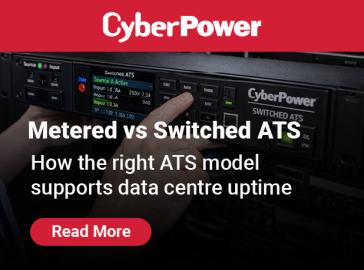
A brief power interruption can undo months of careful planning. In many environments, even a few seconds of downtime can break applications, interrupt services, and damage customer trust. As Australian organisations rely more on digital platforms, the pressure on data centre uptime continues to rise.
Power redundancy is no longer a “nice to have”. Instead, it is a baseline requirement. However, many outages still occur because single-corded equipment depends on only one power source. When that source fails, systems go dark.
This is where automatic transfer switches play a critical role. An ATS ensures that power shifts automatically between two sources without manual intervention. Yet, not all ATS models deliver the same value. Too often, organisations select devices based on price alone. As a result, they miss features that directly affect resilience and operational efficiency.
At Bluechip IT, we work with Australian resellers and partners every day. As a local distributor, we support power protection strategies using proven vendors like CyberPower, without overselling or unnecessary complexity.
In this article, we explain how to choose between metered and switched ATS models. We will explore where each fits, how they affect risk, and why the right decision matters for long-term uptime.
The Real Cost of Downtime: Why Power Resilience Comes First
Downtime is not theoretical. It is measurable, expensive, and common. According to the Uptime Institute’s Annual Outage Analysis 2023, over 60% of data centre outages result in losses exceeding USD $100,000, with power-related failures remaining one of the leading causes.
Because of these risks, organisations increasingly focus on redundancy at every layer. Power distribution sits at the core of that effort. Without it, even the best infrastructure designs fall short. Therefore, selecting the right automatic transfer switch ATS directly supports business continuity goals.
What Is an Automatic Transfer Switch (ATS)?
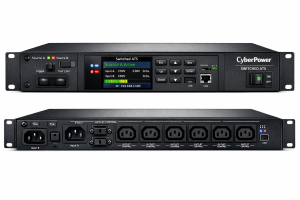
An automatic transfer switch is a power device that connects equipment to two independent power sources. When the primary source fails, the ATS switches to the secondary source automatically. This process happens in milliseconds.
Because of this speed, auto transfer switches protect single-corded servers, storage, and network devices. These assets cannot accept dual power feeds.
In Australian data centres, ATS units often sit inside the rack. They work alongside UPS systems and PDUs. The UPS provides battery backup. The PDU distributes power. Meanwhile, the ATS selects the active source.
Together, these components form a layered defence against outages. Without an ATS, redundancy strategies remain incomplete.
Metered ATS Explained: When Visibility Is the Priority
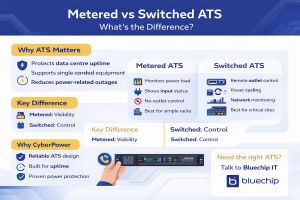
A metered ATS focuses on monitoring rather than control. It automatically switches between power sources while providing visibility into load and input conditions.
Key Features of a Metered ATS
- Real-time load monitoring
- Input source status visibility
- Local LCD for quick checks
- Basic network monitoring on select models
Because of these features, a metered ATS suits environments where teams want insight without complexity.
Best-Fit Use Cases
Metered ATS models work well for:
- Small to mid-size racks
- Cost-sensitive deployments
- Sites with on-site staff
- Environments that prioritise visibility over control
In these scenarios, the ATS supports automatic transfer switch Australia requirements without overengineering.
Limitations to Consider
However, metered ATS units lack outlet-level control. They cannot reboot devices remotely. They also offer limited automation. Therefore, partners should explain these trade-offs clearly.
Metered models provide confidence. Yet, they do not deliver full operational flexibility.
Switched ATS Explained: When Control and Resilience Matter
A switched ATS builds on the same transfer function. However, it adds control, automation, and remote management.
Advanced Capabilities
Switched ATS models typically include:
- Individual outlet control
- Remote reboot and power cycling
- Network-based monitoring
- Event logging and alerts
Because of these features, switched ATS devices support modern operations at scale.
Where Switched ATS Fits Best
Switched ATS units are preferred in:
- High-density racks
- Managed services environments
- Remote or unmanned facilities
- Multi-site deployments
In addition, they support uptime data centre certification goals by improving control and audit readiness.
When systems fail at 2 a.m., remote access matters. A switched ATS reduces response times and operational risk.
Metered vs Switched ATS: Key Differences That Matter
The choice between metered and switched ATS models shapes daily operations.
Metered ATS focuses on monitoring. Switched ATS focuses on control.
Metered units suit on-site teams. Switched models support remote management.
For MSPs, switched ATS often improves efficiency. Engineers can resolve issues without visiting the site. As a result, service quality improves while costs fall.
Over time, scalability also matters. Switched ATS units adapt better as environments grow.
How ATS Choice Impacts Data Centre Uptime
An ATS plays a direct role in preventing single points of failure. Without it, single-corded devices rely on luck.
However, uptime requires more than switching power. Monitoring also matters. Tools such as net uptime monitor platforms rely on clean power signals. When power fluctuates, monitoring alerts spike.
By choosing the right ATS, organisations align power resilience with service level agreements. They also support compliance and reporting requirements.
Most importantly, uptime planning must consider operations. Hardware alone cannot guarantee continuity. The right auto transfer switch bridges that gap.
Why CyberPower ATS Models Suit Australian Partners
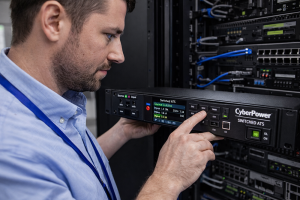
CyberPower ATS models are designed for real-world uptime data centre demands. They support single-corded equipment across racks and edge environments.
Their designs integrate easily with broader power protection portfolios. This simplifies deployment and maintenance.
For Australian partners, local availability matters. Through Bluechip IT, partners access stocked models, fast delivery, and local warranty support. This reduces risk during critical deployments.
How Bluechip IT Helps Partners Choose the Right ATS
Choosing an ATS is not just a technical decision. It is a design decision.
Bluechip IT supports partners with:
- Pre-sales guidance for solution design
- Access to metered and switched ATS models
- Fast quoting across Australia
- Distributor-backed warranty handling
Need help matching ATS models to your customer’s uptime goals? Visit Bluechip IT to access CyberPower ATS solutions and expert pre-sales support.
Key Questions Partners Should Ask Before Recommending an ATS
Before recommending an ATS, partners should ask:
- Do they need monitoring only, or remote outlet control?
- Is the environment staffed or unmanned?
- Will the rack density increase over time?
- Are audits or uptime certifications required?
Clear answers lead to better recommendations. Better recommendations lead to stronger trust.
Choosing the Right ATS Is About More Than Power
Metered ATS models suit visibility-first environments with simple needs. They offer insight at a controlled cost.
Switched ATS models support control, resilience, and managed services. They enable faster response and better scalability.
Ultimately, the right automatic transfer switches strengthen customer confidence and long-term uptime.
By partnering with Bluechip IT, resellers gain access to proven CyberPower solutions, local support, and expert guidance.
Ready to Design Reliable Power Protection?
Build smarter ATS solutions with confidence. Work with Bluechip IT to deliver the right CyberPower ATS for every environment.