Most organisations don’t start with a broken security model. It usually builds up over time. A tool gets added here. Another solution gets layered in later. Eventually, you end up with something that works, but only just. It’s not always consistent, and it’s definitely not easy to scale.
At the same time, the environment has changed. Businesses are using more cloud services, more remote access, and more connected systems than before. That also means more risk. So the old way of handling partners and MSP network security starts to show its limits.
This is where an enterprise cybersecurity strategy becomes useful. Not because it sounds more advanced, but because it brings structure to something that often feels scattered.
At Bluechip IT, we work with partners as a cybersecurity distributor, helping them make sense of the options available. In this article, we’ll walk through how organisations can strengthen their approach and avoid common security gaps as they grow.

Why Enterprise Network Security Needs an Enterprise Approach
If you look at how most environments operate today, it’s not simple anymore. Users log in from different locations. Systems sit across cloud and on-prem setups. Devices move in and out of networks constantly. That alone creates more exposure.
There’s also data to support this shift. The Australian Cyber Security Centre reported a 23% increase in cybercrime in a recent year. That number tells a fairly straightforward story. Threats are increasing, and they’re not slowing down.
Because of that, clients expect more than basic protection. They want to know that there’s a clear plan behind the tools being used. An enterprise IT security approach helps bring that clarity. It doesn’t remove complexity, but it does make it more manageable.
Core Components of an Enterprise Cybersecurity Strategy
Network Visibility and Monitoring
One of the first challenges organisations face is visibility. It’s hard to respond to something you didn’t see in the first place. That’s where centralised monitoring is important.
Instead of checking systems individually, everything feeds into one place. Patterns become easier to spot. Small issues don’t stay hidden for long.
Tools like SIEM or XDR help with this, but the real value is the visibility they provide.
Firewall & Network Protection
A lot of setups still rely on traditional firewalls. They do the job, but only to a point. Modern firewall & network protection works differently. It looks at behaviour, not just traffic rules.
Segmentation also plays a role here. If one area is compromised, it doesn’t automatically affect everything else. That kind of separation can limit damage quite a bit.
Identity and Access Management (IAM)
Access tends to grow quietly over time. People change roles, but permissions stay the same. Admin rights get handed out for convenience. Eventually, there’s more access than there should be.
That’s where IAM becomes important. Applying least privilege sounds simple, but it’s often overlooked. MFA helps as well. It’s not complicated to implement, yet it still stops a lot of attacks.
Patch and Vulnerability Management
Patching is one of those things everyone knows they should do. Still, it gets delayed. Sometimes it’s because of workload. Other times, it’s just not prioritised.
The problem is that attackers often look for known vulnerabilities. So delays create easy opportunities. Automation helps reduce that gap. It keeps things moving without needing constant attention.
Incident Response and Recovery
Even strong environments experience incidents. What matters more is how prepared you are when something happens.
Without a plan, response tends to slow down. Teams spend time figuring out what to do instead of acting. Backups also make a difference here. They don’t prevent incidents, but they do make recovery faster and less disruptive.
At Bluechip IT, we support organisations as an IT security distributor, helping align solutions with real business needs.
Explore how we support organisations with enterprise-focused security solutions.
Common Security Gaps Organisations Must Address
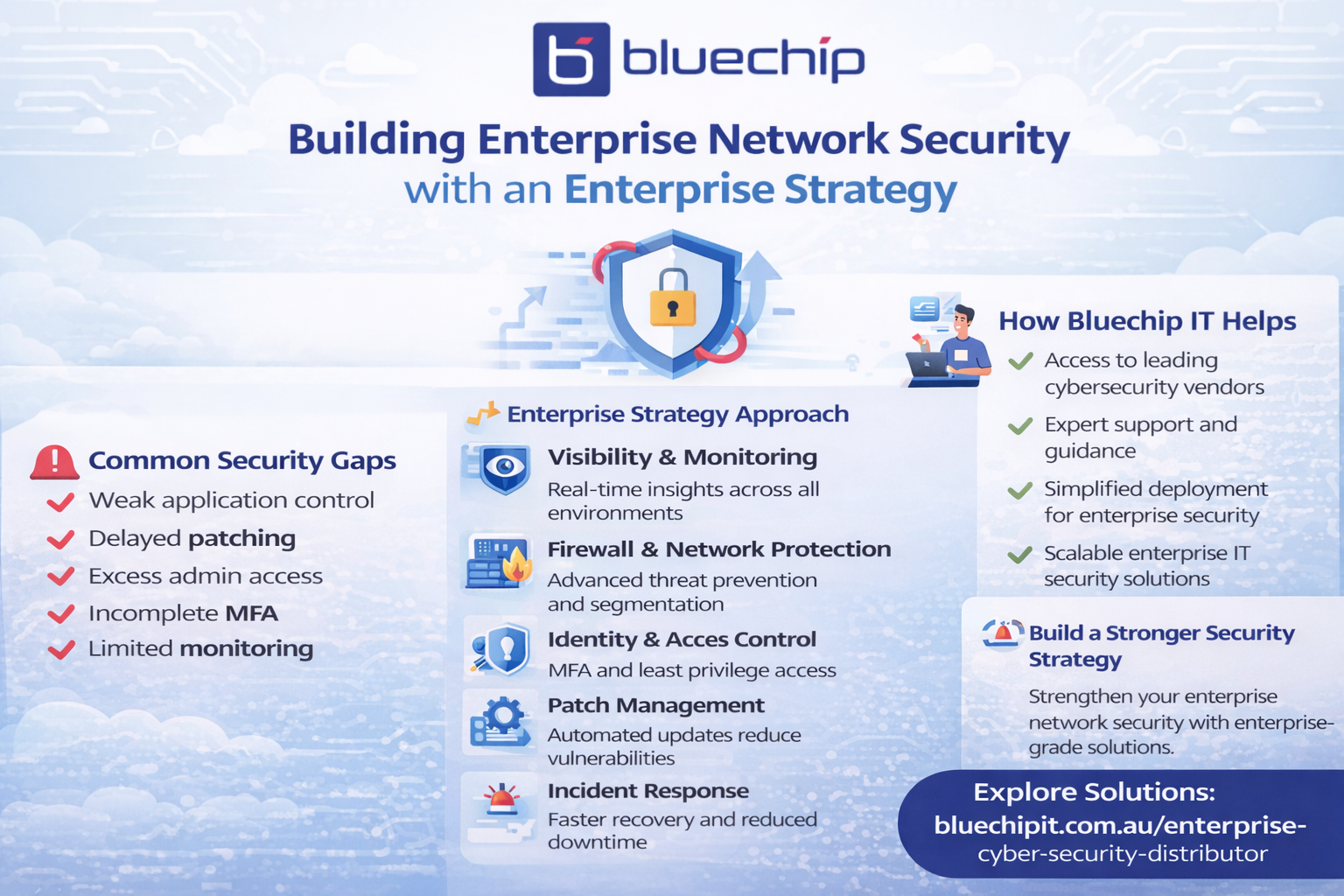
Some gaps are easy to miss because they don’t cause immediate problems. Weak application control is one example. Delayed patching is another. Admin privileges are often broader than necessary.
MFA might be enabled in some areas but not others. Monitoring can also be inconsistent, depending on the client. None of these issues seem critical on their own. Together, though, they increase risk.
From a client’s perspective, that risk matters. It affects trust, even if nothing has gone wrong yet.
How Cybersecurity Distributors Enable Enterprise Success
There’s a point where adding more tools doesn’t solve the problem. What helps more is having the right mix of solutions, along with guidance on how they fit together. That’s where a cybersecurity distributor becomes useful.
Instead of navigating options alone, organisations gain access to proven vendors and expert advice. This reduces complexity and speeds up decision-making.
Building a Scalable Enterprise Security Offering
As organisations grow, things can become harder to manage. Different clients may have different setups. Over time, that creates inconsistency.
Standardising your security stack helps reduce that complexity. It doesn’t remove flexibility, but it gives you a solid base.
Tiered offerings also help. Some clients need basic coverage, while others require more advanced protection.
Many providers are also shifting towards managed services. For a cyber security reseller, that creates more predictable revenue and stronger client relationships.
Choosing the Right Enterprise Security Solutions
It’s easy to focus on features when choosing tools. However, integration matters just as much. If solutions don’t work well together, visibility and control suffer.
Aligning with frameworks like Essential Eight or Zero Trust can help guide decisions. It provides structure without being overly restrictive. Working with an IT security distributor also makes this process easier. It reduces the risk of ending up with disconnected tools.

Future Trends in Enterprise Network Security
There’s a clear shift happening in how security is handled. AI is being used more often in threat detection. It helps identify unusual behaviour earlier.
Zero Trust is also gaining attention. It changes how access is verified across environments. Automation continues to grow as well. It reduces manual work and improves response times.
At the same time, compliance requirements are increasing. Organisations need to stay aware of these changes.
Conclusion
Security has become more demanding, not less. Relying on reactive setups is becoming harder to justify. A structured enterprise cybersecurity strategy offers a more stable way forward.
It strengthens partners and MSP network security, reduces risk, and supports long-term growth. With the right support, organisations can build a more resilient and scalable security approach.
Strengthen Your Security Approach
Build a more structured and scalable cybersecurity strategy with the right partner support.