Cyber attacks are no longer rare events. For many organisations, they are part of daily operations. That’s the reality in 2026.
Most businesses already know about the Essential Eight cyber security framework. Many even claim they are aligned with it. However, when you look closer, the story changes. Gaps still exist. And those gaps are often where attacks succeed.
In many environments, the issue is not awareness. Instead, it is execution. The Essential Eight implementation looks complete on paper, yet falls short in practice.
This is where partners play a critical role. With the right tools and guidance, they can help customers move beyond surface-level compliance. At BluechipIT, we work closely with partners by providing access to cybersecurity solutions that support stronger ACSC Essential Eight outcomes.
So, what are the real gaps in Essential eight security, and how can partners solve them? Let’s break it down.

What is the Essential Eight and Why It Still Matters in 2026
The Essential Eight, also known as the Essential 8 ACSC framework, was created to reduce common cyber risks. It focuses on eight practical controls that organisations can apply. Rather than aiming for perfection, it sets a baseline. In other words, it helps businesses get the fundamentals right first.
Even now, the framework remains highly relevant. In fact, many organisations use it as a starting point for broader Essential eight cyber mitigation strategies. According to the Australian Cyber Security Centre, implementing the Essential Eight can greatly reduce exposure to common threats.
Because of this, the Essential eight ACSC framework continues to shape security standards, compliance efforts, and even cyber insurance requirements.
Why Many Essential Eight Implementations Fall Short
At first glance, the 8 essential controls seem straightforward. However, real-world implementation is rarely simple.
For starters, many organisations treat the Essential eight cyber framework as a checklist. They aim to tick boxes instead of building a strategy. As a result, controls may exist, but they are not effective. At the same time, visibility is often limited. Teams may not have a clear view of endpoints or user activity. Without that visibility, gaps are easy to miss.
Then there is the issue of manual work. Patching, monitoring, and reporting often rely on disconnected tools. Consequently, delays happen. Finally, some solutions do not align well with Essential eight cyber mitigation strategies. This creates a mismatch between what is required and what is actually delivered.
Explore solutions that simplify and strengthen your Essential Eight approach.
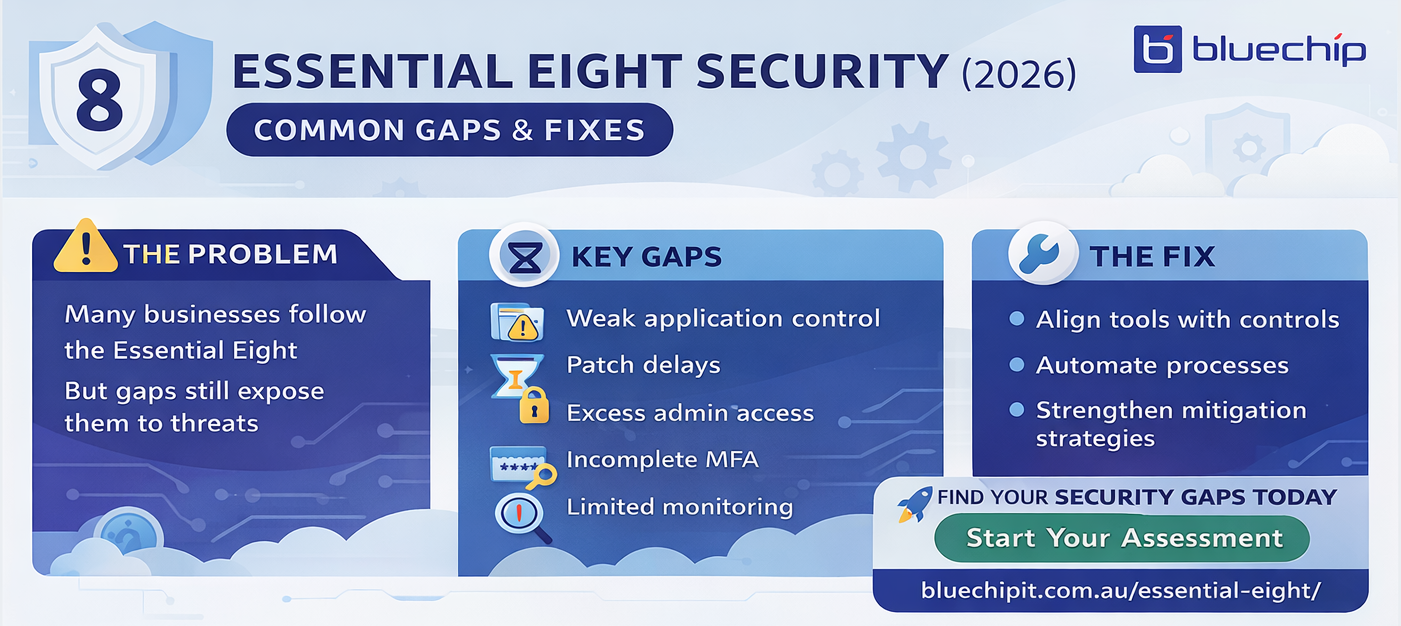
Common Essential Eight Security Gaps in 2026
Weak Application Control
Application control remains a challenge for many teams. While allowlisting exists, it is not always enforced properly. In some cases, organisations still rely heavily on traditional antivirus. However, modern threats can bypass these tools. Without stronger controls, risk remains.
Inconsistent Patch Management
Patching sounds simple, yet it often falls behind. Some systems miss updates. Others are delayed due to operational concerns. As a result, vulnerabilities stay open longer than expected. Attackers take advantage of this. Therefore, even small delays can lead to larger issues.
Privileged Access Mismanagement
Privileged access is another common gap. Users often have more access than they need. Over time, this increases risk. If credentials are compromised, attackers gain deeper control. In addition, monitoring is not always consistent. This makes detection harder.
MFA Gaps and Identity Risks
Many organisations have adopted multi-factor authentication. However, coverage is not always complete. Some applications still rely on passwords alone. Meanwhile, identity policies may lack strength. Because of this, phishing attacks continue to succeed.
Limited Logging and Monitoring
Logging plays a key role in detection. Yet not all organisations collect enough data. Even when logs are available, they are not always reviewed in real time. As a result, threats can go unnoticed for longer periods.
How IT Partners Can Close Essential Eight Gaps
Aligning Solutions with Essential Eight Controls
First, partners need to align solutions with each control. This ensures nothing is overlooked. More importantly, integrated solutions improve consistency. They also reduce gaps between tools.
Automating Essential Eight Implementation
Next, automation helps remove manual bottlenecks. It improves accuracy. It also speeds up processes. Over time, this leads to better outcomes across the Essential eight implementation journey.
Strengthening Essential Eight Cyber Mitigation Strategies
Beyond that, partners should focus on improvement. Security does not stand still. Therefore, strategies must evolve. Advanced detection and response capabilities now play a bigger role.
Delivering Essential Eight as a Managed Service
Finally, managed services offer a practical path forward. They provide continuous monitoring. They also reduce the burden on internal teams. For partners, this creates a steady revenue stream while delivering real value.

The Partner Opportunity in 2026
Demand for Essential eight security expertise continues to grow. At the same time, many organisations still struggle to apply the framework effectively. This creates a clear opportunity.
Partners can bundle solutions across endpoint, identity, and monitoring. More importantly, they can guide customers through each stage of the process. Over time, this builds trust. It also positions partners as long-term advisors.
Final Thoughts: From Compliance to Real Security
The Essential 8 is a strong starting point. However, it is not enough on its own. Without proper execution, gaps will remain. And those gaps create risk.
The good news is that these issues are solvable. With the right approach, partners can help customers strengthen their Essential eight cyber security posture in a meaningful way.
Find Your Essential Eight Gaps Today
Understand where your security stands and identify the gaps that matter most.