Cybersecurity gaps rarely show up until it is too late. One missed patch or one weak login can open the door to serious risk. For many organisations, the challenge is not awareness. It is knowing where they actually stand.
That is where the Essential 8 comes in. Developed by the Australian Cyber Security Centre, this framework outlines practical steps to reduce common cyber threats. It focuses on what works, not just what sounds good on paper, making The essential 8 cyber security approach practical for real-world environments.
At Bluechip IT, we work with resellers and partners who are helping customers navigate Essential eight cyber security requirements. With the right mix of vendors and support, improving security becomes far more achievable.
This blog walks you through a simple checklist to assess your essential 8 maturity level and uncover where action is needed next.

What Is the Essential Eight and Why It Matters
The Essential eight cyber framework is built around eight core strategies. Each one targets common attack methods, including ransomware and credential misuse, as outlined in Essential eight acsc guidance.
More importantly, these controls do not focus on theory. Organisations implement them in real environments.
According to the Australian Cyber Security Centre, the Essential Eight can help organisations prevent a large portion of targeted cyber attacks.
Because of this, the framework is widely adopted across Australia. It applies to small businesses, enterprises, and even government supply chains. Many organisations align with Acsc essential 8 as a baseline for security.
For partners, this creates a clear opportunity. Customers are actively looking for guidance on essential eight implementation.
Understanding Essential 8 Maturity Levels
Overview of Maturity Levels (0–3)
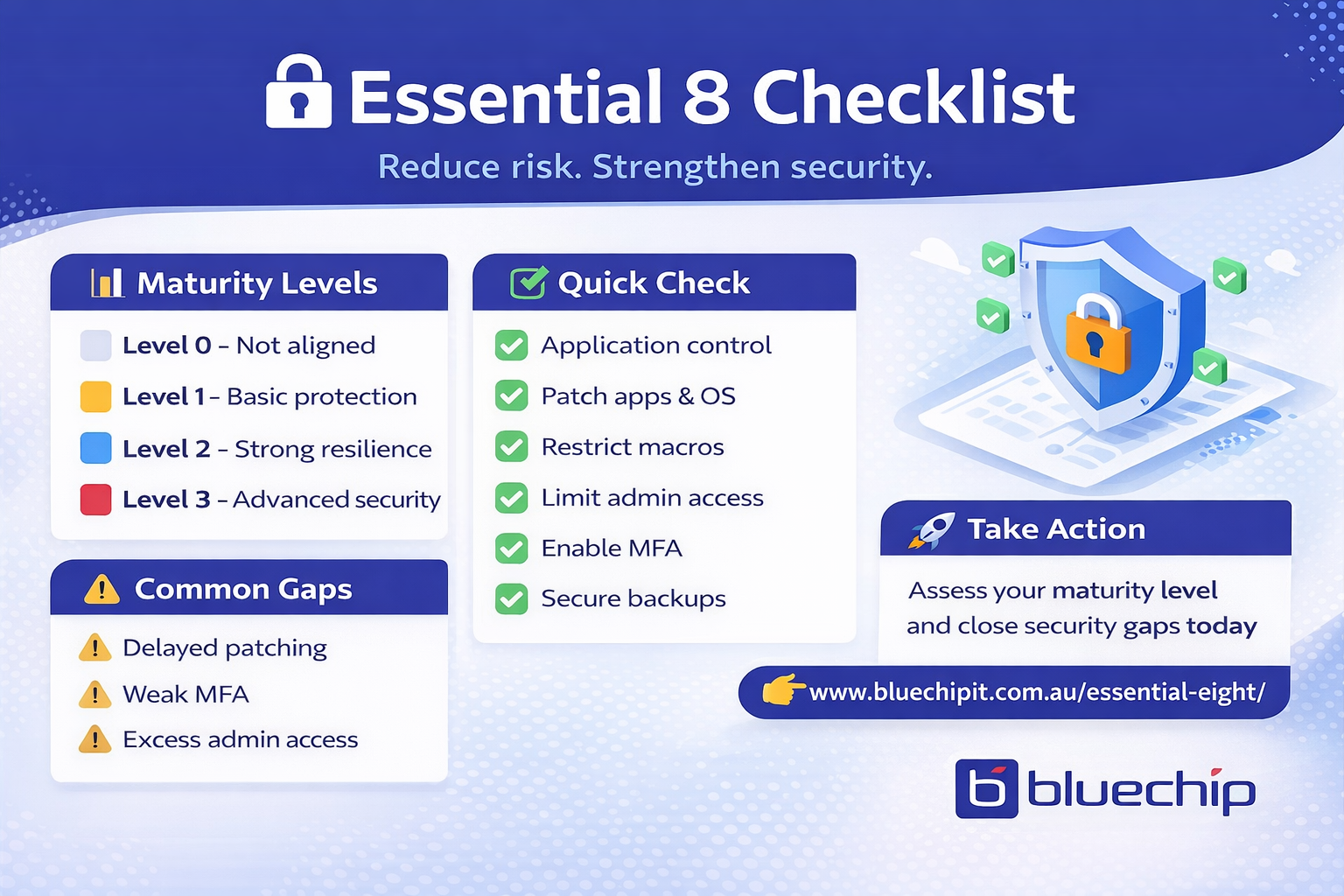
The essential eight maturity levels show how effectively each control is applied across all 8 essential strategies.
Level 0 means little to no alignment. Controls may exist, but teams apply them inconsistently or leave them incomplete.
Level 1 introduces basic protections. This reduces exposure to common threats. However, gaps still remain.
Level 2 is where things become more reliable. Teams apply controls more consistently, which improves resilience.
Level 3 goes further. It supports organisations facing targeted or advanced threats.
The jump from essential 8 maturity level 1 to essential 8 maturity level 2 is often the most important. Level 1 covers the basics. Level 2 strengthens execution across the board.
That is why many organisations aim for Level 2 as a realistic and effective benchmark.
Essential 8 Checklist: Assess Your Current Maturity Level
Use this checklist to review how your organisation aligns with essential eight cyber mitigation strategies. You do not need perfect answers. What matters is honesty.
Application Control
- Can you prevent unapproved applications from running?
- Are admin privileges tightly limited?
Patch Applications
- Are updates applied within recommended timeframes?
- Do you prioritise critical vulnerabilities?
Configure Microsoft Office Macro Settings
- Are macros blocked from unknown sources?
- Are policies enforced consistently?
User Application Hardening
- Are risky features like Flash removed or disabled?
- Are browsers configured securely?
Restrict Administrative Privileges
- Do only the right people have admin access?
- Are those activities monitored and logged?
Patch Operating Systems
- Are operating systems updated without delay?
- Can you track patch compliance clearly?
Multi-Factor Authentication (MFA)
- Is MFA required for remote access?
- Is it enforced for privileged users?
Regular Backups
- Are backups performed on a regular schedule?
- Have you tested recovery recently?
If you are unsure where you stand, we can help you map this quickly with the right vendor solutions.
How to Score Your Essential Eight Maturity Level
After working through the checklist, your overall position should become clearer.
If several controls are missing or only partly applied, you are likely at essential 8 maturity level 1 or below. At this stage, security is present but not consistent.
If you see a mix of strong and weak areas, you are moving between Level 1 and Level 2. This is a common position for many organisations working through essential eight implementation.
On the other hand, if most controls are well enforced and regularly maintained, you are closer to essential 8 maturity level 2 or higher.
That said, maturity is not just about ticking boxes. A single weak control, like patching or MFA, can still expose the business. Because of this, consistency across all eight strategies matters just as much as progress in individual areas.
Common Gaps in Essential Eight Implementation
Even with good intentions, gaps often remain. For example, many organisations lack full visibility across endpoints. This makes enforcement difficult.
Patching is another common issue. Teams delay updates, which leaves known vulnerabilities exposed. Teams sometimes apply MFA only in certain areas. That creates weak entry points.
Teams also overuse admin privileges. This increases the risk of misuse or compromise. These gaps are common, but teams can fix them.
How to Improve Your Essential 8 Maturity Level
Improvement does not need to be overwhelming. Start with the controls that offer the biggest impact. MFA is a strong first step. It adds immediate protection.
Next, tighten patching processes. Faster updates reduce risk quickly. Automation can also help. It reduces manual effort and improves consistency.
At the same time, working with the right partner can speed things up. Access to proven tools and expertise makes a big difference. Regular reviews should follow. Security does not stay static, and your environment does not either.

How Bluechip Supports Essential Eight Compliance
Bluechip IT supports partners with access to trusted cybersecurity vendors aligned with the Essential 8 acsc framework.
We help you:
- Identify gaps through structured assessments
- Deliver the right mix of security solutions
- Support essential eight implementation across environments
- Maintain ongoing protection through monitoring
This allows you to focus on your customers while strengthening your security offering.
Conclusion
The Essential eight security framework provides a clear path forward. However, progress starts with understanding where you are today.
A simple checklist can reveal more than expected. It highlights both strengths and gaps.
From there, improvement becomes more focused and manageable.
Over time, aligning with ACSC mitigation strategies strengthens not only security, but also confidence.
🚀 Know Your Essential 8 Maturity Level
Get clarity on your current security posture and next steps
Understand your gaps and align with Essential Eight cyber security strategies.