Managing multiple tools should make life easier. However, many MSPs and resellers feel the opposite. You jump between dashboards, chase alerts, and fix gaps. As a result, productivity drops while risks increase.
More tools do not always mean better outcomes. Instead, tool sprawl often creates confusion, delays, and higher costs. It also makes it harder to maintain consistent service delivery across every managed endpoint.
At the same time, clients expect stronger security and faster response. That pressure continues to grow. Therefore, simplifying your stack is no longer optional. It is a practical step towards better operations and stronger margins.
At Bluechip IT, we support partners with cybersecurity solutions that reduce complexity. We help resellers align tools that actually work together.
In this article, we explore how to simplify patch management, backup services, and remote access while improving efficiency and security outcomes.

The Hidden Cost of Too Many Tools
Tool sprawl creates more problems than most teams expect. While each tool solves a task, together they create friction. According to Ponemon Institute, organisations use an average of over 40 security tools, increasing complexity and reducing efficiency.
This shows a clear pattern. Complexity increases risk and cost.
In daily operations, the impact is easy to see. Teams switch between platforms too often. They lose time and miss critical updates. In addition, data becomes inconsistent across systems.
Costs also rise quickly. Licensing, training, and management overhead all increases. Meanwhile, gaps appear between tools. These gaps can lead to missed security patches or failed backups.
For partners, this affects growth. It becomes harder to scale services. Margins shrink, and service delivery becomes inconsistent.
Why Patch, Backup & Remote Access Must Work Together
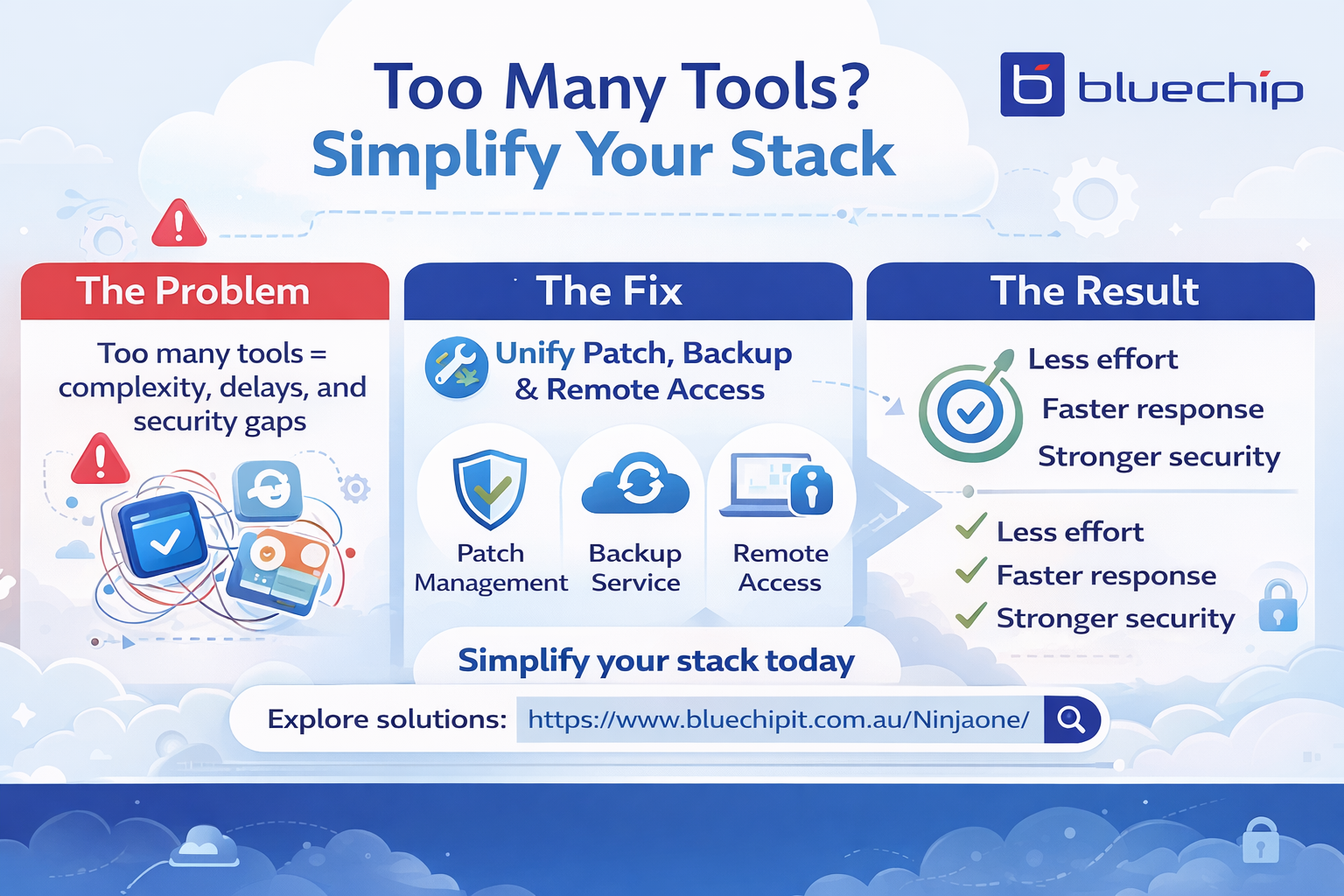
Patch management, backup, and remote access are not separate tasks. Instead, they rely on each other.
Patch management helps close vulnerabilities. Without it, systems remain exposed. At the same time, backup services protect data when something goes wrong. This includes ransomware and accidental loss.
Remote access allows teams to respond quickly. It enables faster troubleshooting and recovery.
However, problems arise when these tools operate in isolation. A missed patch can lead to an attack. Then, a failed backup can make the recovery impossible.
Because of this, integration matters. When these functions work together, response time improves. Visibility also becomes clearer across every managed endpoint.
Patch Management: The First Line of Defence
Patch management plays a critical role in security. It ensures that known vulnerabilities are fixed quickly.
Without regular updates, systems remain exposed to threats. Attackers often target outdated software. Therefore, timely security patches are essential.
Automation helps reduce this risk. It ensures updates are applied consistently across all endpoints. In addition, centralised control improves visibility.
For MSPs, this creates efficiency. Teams can manage every managed endpoint from one place. As a result, they reduce manual work and avoid missed updates.
Backup Services: Your Safety Net
Even with strong patching, incidents can still happen. That is why a reliable backup service is essential.
Backup services for businesses protect critical data from loss. They also support fast recovery after ransomware attacks.
Online backup services offer flexibility and accessibility. Teams can restore data quickly from anywhere. Meanwhile, cloud backup services Australia help meet compliance and data sovereignty requirements.
However, not all backup solutions are equal. Consistency and reliability matter most. If backups fail, recovery becomes impossible.
Looking to simplify your backup and security strategy? Explore integrated solutions that support your MSP growth.
👉 Visit Bluechip IT for NinjaOne Solutions
Remote Access: Enabling Fast, Secure Support
Remote access is now a core part of MSP operations. It allows teams to respond without delay.
Secure remote access reduces downtime. It also improves customer experience. Technicians can resolve issues without waiting for onsite visits.
When integrated with patch management and backup, remote access becomes even more powerful. Teams can deploy updates, monitor systems, and recover data from a single workflow.
This reduces complexity while improving response time.
The Case for Consolidation
Simplifying your stack starts with consolidation. Instead of using many disconnected tools, MSPs can adopt unified platforms.
This approach offers several benefits. First, it reduces operational complexity. Teams spend less time switching between systems.
Second, it improves visibility. You can monitor patching, backup, and access in one place. This leads to better decision making.
Third, automation is becoming easier. Reporting and workflows can run smoothly across all functions.
For partners, the impact is clear. Service delivery becomes more consistent. Solutions have become easier to scale. Profitability also improves over time.

How Bluechip IT Helps Partners Simplify Their Stack
Bluechip IT works closely with MSPs and resellers across Australia. We provide access to trusted cybersecurity vendors.
Our solutions support patch management, backup service, and remote access in one ecosystem. This helps partners reduce tool sprawl and improve efficiency.
We also offer enablement and local expertise. Partners gain guidance on selecting and integrating the right solutions.
More importantly, we focus on long-term growth. Our goal is to help partners build scalable and repeatable services.
We are not just distributors. We are a strategic partner in your success.
Conclusion
Too many tools can slow your business down. They create complexity, increase risk, and reduce efficiency.
On the other hand, simplification brings clear benefits. It improves visibility, strengthens security, and supports growth.
By aligning patch management, backup services, and remote access, MSPs can deliver better outcomes. They can also scale with confidence.
The future of managed services is not about adding more tools. It is about using the right ones, together.
Simplify Your Enterprise Stack Today
Reduce complexity and improve your security strategy with the right solutions.