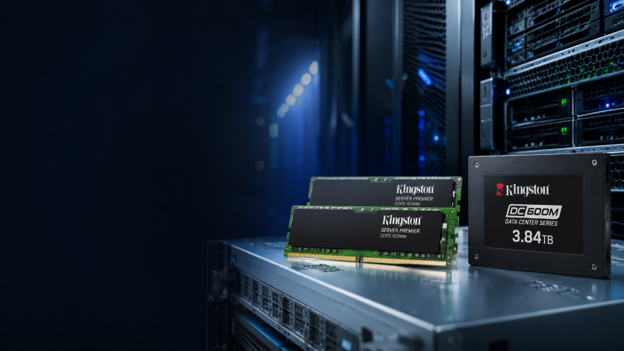
Enterprise infrastructure is being asked to handle more demanding workloads while maintaining reliability, performance and uptime. From virtualisation and cloud environments to databases, AI and high-performance computing, server memory and storage can have a direct impact on how well these systems perform.
For resellers and MSPs supporting enterprise customers, Kingston Server Premier Memory and Kingston Data Center SSDs provide server-grade memory and storage solutions designed for demanding business environments. Through Bluechip Infotech, Australian channel partners can access Kingston solutions for server upgrades, infrastructure refreshes and new deployments.
Why Server Memory and Storage Matter
Server performance is not determined by processing power alone. Memory capacity, memory reliability and storage performance all affect how efficiently business-critical workloads operate.
Insufficient or incompatible server RAM can contribute to instability and performance bottlenecks, while storage that is not designed for sustained enterprise workloads can struggle to deliver predictable performance over time.
Purpose-built enterprise server memory and data centre SSDs are designed to address these requirements with greater reliability, endurance and consistency than products intended for everyday desktop use.
What Is Kingston Server Premier Memory?
Kingston Server Premier is server-grade ECC memory designed for enterprise servers and data centre environments where reliability, compatibility and long-term consistency are critical.
The Server Premier range includes DDR5 RAM and DDR4 server memory, with ECC Registered DIMM (RDIMM) and unbuffered configurations available for different server platforms. Kingston currently offers DDR5 Server Premier memory at speeds of up to 6400MT/s and capacities of up to 128GB per module, depending on configuration.
According to Kingston’s Server Premier specifications, the range is built around server-grade components, production testing and platform validation to support reliable server deployments.
Why Controlled BOM Matters for Server Memory
Server fleets are often expanded or upgraded over several years rather than all at once. Maintaining consistent components can therefore be important when businesses need to add capacity to existing systems.
Kingston Server Premier DRAM solutions use a Controlled BOM model with locked DRAM die revisions. This provides greater component consistency throughout the product lifecycle, helping reduce the need to repeatedly requalify memory when expanding compatible server deployments.
For resellers, system integrators and MSPs, this can simplify future upgrades and help reduce compatibility-related issues.
Why ECC Memory Is Important for Enterprise Servers
ECC, or Error-Correcting Code, memory can detect and correct certain memory errors before they result in corrupted data or system instability.
Kingston’s guide to ECC memory and enterprise SSDs explains how ECC memory helps detect and correct single-bit errors, supporting reliability in server environments.
This makes ECC memory particularly valuable in environments where systems operate continuously or support business-critical workloads.
Typical applications include:
- Data centres
- Virtualised infrastructure
- Cloud environments
- Databases
- Business-critical servers
- High-performance computing
- AI and data-intensive workloads
Kingston Server Premier provides ECC memory options for current DDR5 server platforms while continuing to support DDR4 environments, allowing partners to support both new infrastructure and existing server fleets.
What Are Kingston Data Center SSDs?
![Kingston Data Center NVMe and SATA enterprise SSDs.]](https://www.bluechipit.com.au/wp-content/uploads/2026/09/Kingston-Blog-2-1-300x199.webp)
Kingston Data Center SSDs are enterprise-grade solid-state drives designed for continuous server and data centre workloads where endurance, consistent performance and low latency are important.
Unlike consumer SSDs, which are generally designed around lighter and more intermittent workloads, enterprise SSDs are built to handle sustained read and write activity.
Kingston’s current data centre SSD portfolio includes PCIe NVMe and SATA enterprise SSDs for different performance, compatibility and capacity requirements. NVMe SSD solutions can support environments where high throughput and low latency are particularly important. Kingston positions the range for intensive 24/7 operation and workloads including cloud infrastructure, virtualisation, AI, high-performance computing and databases.
Why Use an Enterprise SSD Instead of a Consumer SSD?
Consumer and enterprise SSDs may use similar underlying storage technologies, but they are designed for different operating conditions.
For server environments, the important requirement is not simply achieving a high peak transfer speed. Enterprises also need storage that can maintain predictable performance during sustained workloads.
Kingston enterprise SSDs are designed around factors such as:
- Consistent input/output performance
- Predictable low latency
- High endurance for continuous workloads
- Power-loss protection
- Advanced error correction
- Data security features on supported models
- Performance consistency under sustained demand
Kingston also highlights Quality of Service, endurance and predictable latency as important characteristics of its Data Center SSD portfolio, helping support consistent I/O performance during intensive workloads.
For channel partners, these characteristics make data centre SSDs more appropriate for business-critical servers than consumer-grade drives designed primarily for desktop or general-purpose computing.
SATA or NVMe: Which Enterprise SSD Is Right for the Workload?
The appropriate SSD depends on the server platform and workload.
SATA enterprise SSDs provide broad compatibility and can be a practical option for mixed-use server environments, storage upgrades and infrastructure where SATA interfaces are already deployed.
PCIe NVMe enterprise SSDs provide significantly greater throughput, lower latency and higher IOPS, making them well suited to more performance-intensive workloads such as large databases, virtualisation, AI and high-performance computing. For these environments, an enterprise NVMe SSD can provide the performance characteristics required for more demanding data-intensive workloads.
Kingston’s current enterprise portfolio includes SATA SSDs as well as PCIe NVMe options, allowing partners to match storage performance to the requirements of each deployment.
Supporting AI, Cloud and Data-Intensive Infrastructure

AI, analytics, virtualisation and modern cloud applications can place significant pressure on both memory capacity and storage performance.
As these workloads grow, infrastructure needs to move larger volumes of data between processors, memory and storage efficiently. Increasing DDR5 RAM capacity in supported servers can reduce memory capacity bottlenecks, while high-performance enterprise SSDs can improve storage throughput and latency for data-intensive applications.
Kingston’s broader server and data centre solutions bring server memory and SSDs together for demanding enterprise environments, including virtualised and data-intensive workloads.
For partners planning infrastructure upgrades, considering memory and storage together can help identify performance bottlenecks across the wider server environment rather than addressing individual components in isolation.
How Do You Find Compatible Kingston Server Memory?
Compatibility is one of the most important considerations when upgrading server memory.
Installing the wrong memory type, capacity or configuration can result in instability or prevent a server from operating correctly. Kingston provides a compatibility search tool that allows users to identify appropriate memory based on the server or system being upgraded.
Partners can search using:
- Server or system make and model
- Kingston part number
- Distributor part number
- Manufacturer-equivalent part number
Kingston Server Premier is also qualified across a range of leading server systems and motherboard manufacturers.
If you are unsure which server RAM or Registered DIMM (RDIMM) configuration is appropriate for a customer environment, or which storage solution best meets their requirements, Bluechip Infotech can assist with product selection and compatibility.
The Opportunity for Resellers and MSPs
Memory and storage upgrades can form part of a broader server lifecycle and infrastructure optimisation strategy.
Common opportunities include:
- Expanding memory as customer workloads grow
- Migrating server environments from DDR4 to DDR5 RAM
- Refreshing ageing server storage
- Replacing consumer or legacy drives with enterprise SSDs
- Supporting virtualisation and private cloud projects
- Preparing infrastructure for AI and data-intensive workloads
- Improving server performance without replacing the complete platform
- Including memory and storage reviews within managed infrastructure services
Server memory and enterprise storage can also complement wider infrastructure projects involving servers, NAS, backup, cloud and data centre solutions.
By identifying capacity and performance requirements early, resellers and MSPs can help customers make more deliberate upgrade decisions while creating additional opportunities within existing accounts.
Why Kingston for Enterprise Memory and Storage?
Kingston provides both server memory and enterprise SSDs, giving organisations a reliable choice for two critical parts of their server infrastructure.
But performance specifications are only part of the decision. Consistent components, long-term availability and dependable support are equally important to maintaining business continuity, operational resilience and future scalability.
With nearly four decades of experience across industrial and embedded applications, Kingston understands that long-term infrastructure success goes beyond performance. Quality, reliability and service are equally essential to building infrastructure that meets today’s needs and supports future growth. This approach reflects Kingston’s Built on Commitment philosophy, which places long-term quality, reliability, service and customer trust at the centre of its brand positioning.
Key advantages include:
- Server-grade ECC DDR5 RAM and DDR4 memory
- Registered DIMM (RDIMM) options for supported server platforms
- Platform validation for server systems
- Controlled BOM consistency for Server Premier DRAM solutions
- Enterprise SATA and NVMe SSD options
- Storage designed for 24/7 workloads
- Predictable performance and low latency
- High-endurance enterprise storage options
- Compatibility tools to support product selection
- Solutions for cloud, virtualisation, databases, AI and HPC environments
For enterprise customers, it’s about more than just the product. Kingston’s focus on quality, reliability and service provides support throughout the technology lifecycle — from choosing the right components to future upgrades and expansion.
For Australian resellers and MSPs, Bluechip Infotech provides access to Kingston’s enterprise portfolio, backed by local sales, product and distribution support.
That support can make a real difference when projects involve more than simply choosing a product. Whether it’s checking compatibility, refreshing infrastructure, expanding an existing environment or planning for future needs, having the right support can help partners make informed decisions and keep projects moving. Kingston’s Simply Hosting case study provides an example of this collaborative approach, with Kingston technical teams helping analyse workloads, diagnose issues and guide enterprise SSD selection and configuration.
Frequently Asked Questions
What is Kingston Server Premier memory?
Kingston Server Premier is enterprise-grade ECC memory designed for servers and data centre environments. It uses server-grade DRAM and is designed around testing, platform validation and Controlled BOM specifications to support consistency throughout the product lifecycle.
What is the difference between ECC memory and standard RAM?
ECC memory can detect and correct certain memory errors that could otherwise contribute to data corruption or system instability. It is commonly used in servers and other business-critical systems where reliability is particularly important.
What is the difference between a data centre SSD and a consumer SSD?
Data centre SSDs are designed for continuous and intensive server workloads. Compared with consumer SSDs, they typically prioritise higher endurance, predictable latency, consistent performance and enterprise features such as power-loss protection and advanced error correction.
Should I use SATA or NVMe SSDs in a server?
The right interface depends on the workload and server platform. SATA SSDs offer broad compatibility and can suit many general server workloads, while NVMe SSDs provide higher throughput, lower latency and greater IOPS for more performance-intensive applications.
Are Kingston enterprise SSDs suitable for AI and virtualisation?
Yes. Kingston positions its Data Center SSD portfolio for workloads including AI, high-performance computing, cloud, virtualisation and databases. The appropriate drive should still be selected according to capacity, interface, endurance and workload requirements.
How can I find compatible Kingston memory for a server?
Kingston provides memory selection and compatibility resources to help identify appropriate products for different server platforms. Bluechip Infotech can also assist Australian channel partners with compatible server RAM and ECC memory selection.
Kingston Enterprise Solutions Through Bluechip Infotech
Reliable server infrastructure is about getting the right balance of compute, memory and storage. Kingston Server Premier Memory and Kingston Data Center SSDs give resellers and MSPs reliable, enterprise-focused options to improve capacity, performance, reliability and storage endurance.
While server memory and SSDs serve different purposes, they highlight an important point: choosing infrastructure is about more than comparing specifications. Consistent components, long-term availability and ongoing support can make a real difference to business continuity, operational resilience and future growth.
With nearly four decades of experience across industrial and embedded applications, Kingston understands the importance of getting these fundamentals right. Performance matters, but so do quality, reliability and service. Together, these four pillars help organisations build infrastructure they can rely on today and as their needs grow. Reflected in Kingston’s Built on Commitment philosophy, these principles remain central to supporting customers throughout the technology lifecycle.
Whether you’re expanding a server fleet, planning a DDR5 RAM migration, refreshing enterprise storage or preparing for more demanding AI, cloud and virtualised workloads, Bluechip Infotech can help you find the right Kingston solutions.
For Australian resellers and MSPs, Bluechip Infotech provides local sales, product and distribution support, helping partners with product selection, compatibility and infrastructure requirements. Having the right support behind you can make it easier to plan, deploy and maintain solutions with confidence.
Contact the Bluechip Infotech team to explore Kingston Server Premier Memory and Data Center SSD solutions, check compatibility and access partner pricing.