Cyber threats continue to rise across Australia. Ransomware, phishing, and supply chain attacks now target businesses of every size. As a result, customers are asking sharper questions about their security posture. Many specifically reference the Essential 8 or the Essential eight cyber security framework.
However, knowing about the essential 8 is not the same as delivering it. Many resellers understand the framework. Yet they struggle to turn it into a structured, profitable solution strategy for customers.
That gap often sits between theory and execution. Delivering effective essential eight cyber mitigation strategies requires more than simply choosing tools. It demands architecture, alignment, and long-term planning.
At Bluechip IT, we work closely with resellers across Australia to help them build practical, scalable security strategies. In this article, we explain how a strategic distributor helps partners confidently deliver The Essential Eight cyber security framework while creating lasting customer value.

Understanding the Essential Eight Cyber Security Framework
The Essential eight cyber security framework was developed by the Australian Cyber Security Centre (ACSC). It outlines eight mitigation strategies designed to reduce cyber risk. These 8 essential controls focus on preventing malware, limiting attacker movement, and improving recovery capability.
According to the ACSC, implementing the Essential Eight at appropriate maturity levels can significantly reduce the risk of cyber compromise. The ACSC states that these strategies are designed to make it “much harder for adversaries to compromise systems”.
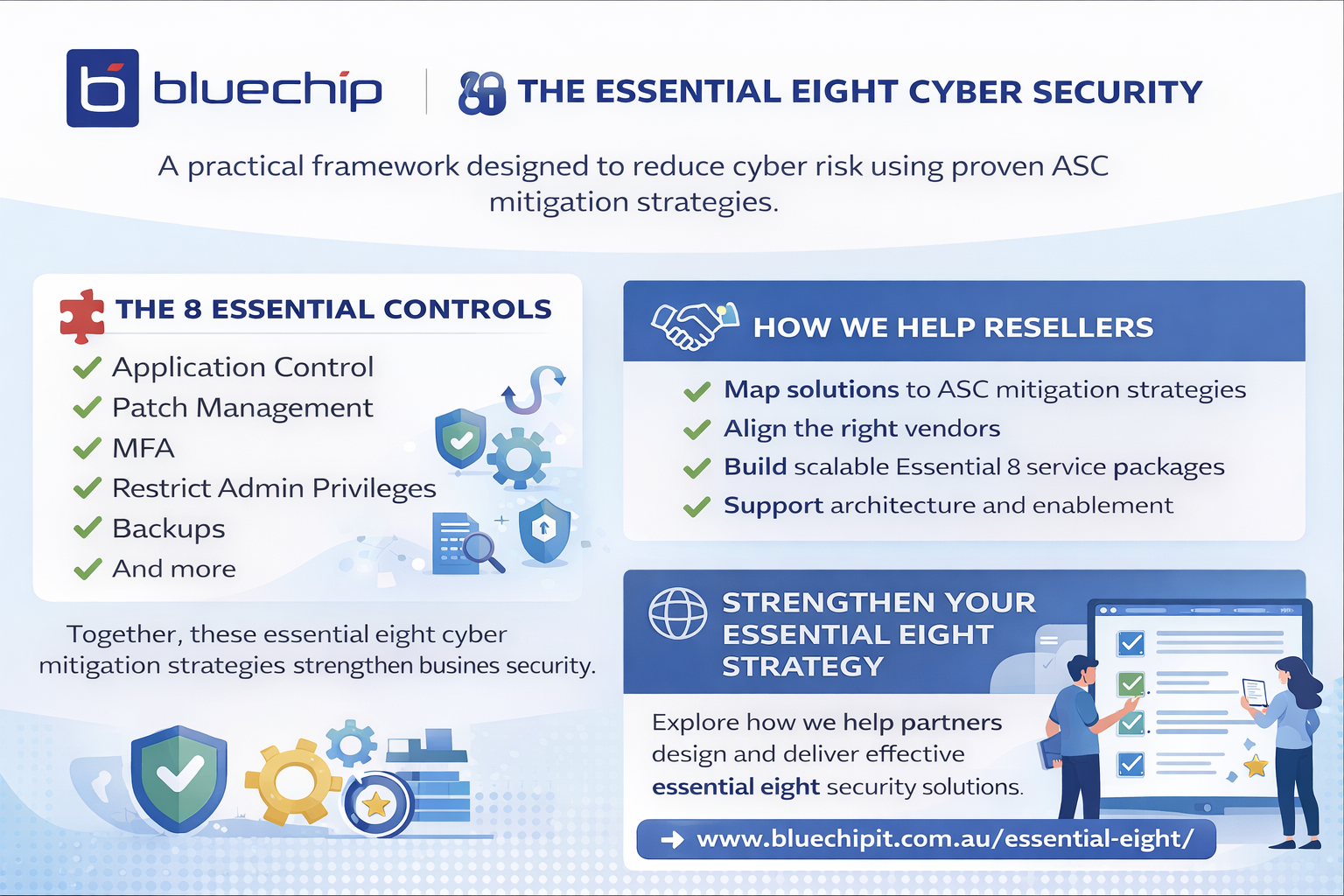
The Essential 8 ASCS framework includes controls such as application control, patch management, multi-factor authentication, and regular backups. Together, these ASC mitigation strategies create a layered defence model.
However, compliance alone does not equal security. Many organizations’ treat the essential eight security framework as a checklist. In contrast, mature organisations treat it as a strategic roadmap. Therefore, the shift from checklist compliance to structured implementation matters more than ever.
The Real Challenge: Turning Essential Eight into Actionable Strategy
Complexity of Essential Eight Cyber Mitigation Strategies
Each of the essential eight cyber mitigation strategies requires technical depth. Application control demands strict policy management. Patch management must cover operating systems and applications. Multi-factor authentication requires identity integration. Backup strategies must protect against ransomware.
Importantly, no single product delivers The essential 8. Resellers must combine multiple technologies. Consequently, solution design becomes complex very quickly.
Customer Maturity Gaps
Customers also sit at different maturity levels. Some operate in hybrid environments. Others rely on legacy systems. Budget constraints for further complicated implementation.
Therefore, applying ASC Essential 8 controls require flexibility. A one-size-fits-all approach simply does not work.
Tool Overload
Vendors frequently claim alignment with Essential eight cyber requirements. Yet not every product fully maps to ASC mitigation strategies. As a result, resellers face confusion. They risk overlapping controls or leaving gaps.
Delivering essential eight security is about solution architecture, not just product selection.
How a Strategic Distributor Enables Essential Eight Security Delivery
This is where a strategic distributor becomes critical.
1. Solution Mapping to ASC Mitigation Strategies
A distributor with security expertise helps map vendor solutions to each ASC mitigation strategy. Instead of guessing, resellers gain structured guidance. This approach ensures alignment with essential eight cyber mitigation strategies while avoiding unnecessary overlap.
We work with partners to design cohesive stacks that address each control properly. Therefore, customers receive clear, defensible solutions.
2. Building Repeatable Essential 8 Service Packages
Resellers need repeatability to scale. A distributor can help structure the essential eight into service tiers. For example, packages may align with different Essential 8 ASCS maturity levels.
By doing so, partners can position essential eight security as a managed service. SMEs then gain achievable pathways to compliance without overwhelming budgets.
Do you want to support designing your Essential Eight solution strategy? Explore how Bluechip IT helps map, bundle, and scale your security offerings.
3. Pre-Sales and Architecture Support
Technical workshops and design validation sessions strengthen proposals. Resellers gain confidence when presenting The Essential 8 cyber security framework to customers.
Additionally, guidance around compliance positioning ensures messaging remains accurate. This support reduces risk and improves close rates.
4. Vendor Ecosystem Alignment
Modern security demands interoperability. Therefore, distributors align endpoint, identity, backup, and monitoring solutions into one cohesive ecosystem.
This integration ensures essential eight cyber strategies scale as customer environments evolve.
5. Enablement and Ongoing Education
Education remains vital. Sales teams must explain ASC Essential Eight clearly. Technical teams must understand implementation depth.
Through enablement programs and certifications, distributors empower partners to speak confidently about Essential eight cyber requirements.
From Compliance to Competitive Advantage
Customers do not only want to tick a compliance box. Instead, they want measurable risk reduction. Resellers who strategically implement the 8 essential mitigation controls stand apart from competitors.
With distributor support, ASC Essential Eight requirements transform into revenue-generating managed services. Rather than reacting to audits, partners lead strategic conversations.
As a result, security shifts from cost centre to value driver.
Building a Scalable Essential Eight Cyber Security Strategy for Customers
A structured process ensures consistency.
Step 1: Assess maturity level.
Review current controls against Essential 8 ASCS standards.
Step 2: Identify gaps against ASC mitigation strategies.
Pinpoint weaknesses across applications, identity, and backups.
Step 3: Map technologies strategically.
Align vendor solutions to essential eight cyber mitigation strategies.
Step 4: Bundle into managed offerings.
Package controls into scalable service tiers.
Step 5: Continuously optimise.
Security evolves, so strategies must adapt.
This disciplined approach ensures essential eight security becomes sustainable rather than reactive.

Why Distribution Strategy Matters More Than Ever
Cyber incidents continue to increase nationwide. Meanwhile, boards now treat cyber risk as a governance issue. Government guidance reinforces the importance of The essential eight cyber security framework.
Consequently, resellers cannot approach implementation casually. Strategic distribution support provides clarity, alignment, and scale.
The Essential Eight is no longer optional. However, successful delivery depends on structured planning and partnership.
Wrapping Up
The Essential 8 cyber security framework is comprehensive and powerful. Yet its complexity creates challenges for resellers. Tools alone cannot deliver compliance or resilience.
Instead, partners need guidance, architecture support, and vendor alignment. Essential eight security becomes far more achievable when a strategic distributor helps design the solution roadmap.
If you want to strengthen your delivery of essential eight cyber mitigation strategies, the right partnership makes all the difference.
Strengthen Your Essential Eight Strategy
Build structured, scalable solutions aligned to ASC mitigation strategies and customer maturity levels.
Partner with Bluechip IT Today >>