Choosing the right IT hardware can feel frustrating. Even when products are strong on paper, deployments often miss expectations. Resellers sell the technology, but something still falls short. Too often, projects fail not because of hardware flaws, but because conversations don’t happen early.
When environments are misunderstood, usage isn’t fully explored, and lifecycle planning is overlooked, outcomes suffer. At Bluechip IT, as a distributor working with a broad vendor ecosystem, we help partners have the right conversations, so hardware selection and rollouts hit the mark. These are the same practical discussions we encourage during our Taste of Success event, where partners, vendors, and specialists connect around real deployment challenges.
In this blog, we’ll unpack why hardware conversations, focused discussions around the environment, usage, and lifecycle, significantly improve IT outcomes. Stay with us to see how this approach saves time, protects reputation, and strengthens client trust.

Why Hardware Decisions Are Rarely Just About Specs
It’s easy to compare products based on spec sheets. Gigabytes. Throughput. Storage capacity. Yet real-world performance often doesn’t match the numbers on paper.
Specs don’t show how a switch behaves under sustained load. They don’t reveal how a server performs when mixed with legacy gear. And they certainly don’t explain what end users actually do with that tech every day.
A report on project failure causes shows that across industries, poor requirements gathering, stakeholder misalignment and miscommunication are consistently cited as primary drivers of IT project failure. In the information technology sector, failure rates can range from roughly 36% to 75%, with misalignment and poor stakeholder communication among the top causes.
This highlights why hardware conversations matter. A deeper dialogue uncovers environment constraints, user behaviour and business priorities — all critical details that raw specs obscure.
Understanding the Customer Environment First
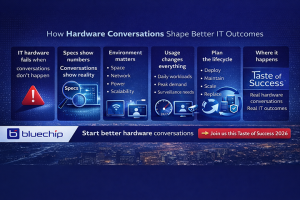
Before picking hardware, resellers must understand the customer’s environment. This goes beyond “what do you need?” It digs into how, where and under what conditions hardware will operate.
Key discussion points include:
- Physical space and layout: Will the hardware live in a server room, office floor, or remote site?
- Network readiness: Does the existing network support the proposed architecture?
- Power, cooling, and scalability: Are UPS, airflow and future expansion considered?
When these points are discussed early, problems are found before installation, not after. Conversations reduce surprises. They reduce last-minute changes. They reduce rework costs.
Usage, Workflows, and Real-World Demands
Hardware performance should reflect real-world usage, not just peak theoretical numbers.
Consider a customer who wants a new surveillance system. A generic camera might look adequate on spec, but if peak hours involve heavy motion tracking, or if analytics is necessary, performance needs change. Without a conversation on usage patterns, a reseller might recommend a system that looks fine but fails in practice.
Understanding usage helps clarify:
- Daily workloads vs peak activity
- Collaboration tools mixing with legacy hardware
- Surveillance video systems combined with storage and network feeds
By talking through workflows, partners can match hardware to actual demands — saving time and increasing satisfaction.
Hardware Lifecycle: Planning Beyond Day One
Too often, lifecycle planning is an afterthought. Partners focus on day-one success and forget what happens in year two, three and beyond.
A good hardware conversation includes:
- Maintenance and support expectations: Who is responsible for updates? What are SLA expectations?
- Scalability and upgrades: Is the install modular? Can it grow?
- End-of-life planning: When will replacement be needed? How will data be migrated?
These discussions protect reseller credibility. They show foresight. They also reduce surprise costs for the end customer.
Hardware Conversations in Security and Surveillance Projects
In security events and information security initiatives, complexity increases. A surveillance system must not only capture footage but also meet compliance and reliability needs.
Missteps in security hardware deployments often stem from shallow discovery. A camera may look capable on paper, but if lighting, frame rate or analytics are mistargeted, the system underperforms.
Deep conversation helps align hardware with:
- Surveillance system requirements
- Regulatory or compliance needs
- Storage needs for video retention
Better planning in the discovery phase means fewer service tickets and more ready-to-run implementations.
The Role of Events in Better Hardware Conversations
Emails and calls are fine for basic tasks, but they struggle with complex hardware discussions. There is a difference between reading a sentence and hearing a story.
This is where technology events and corporate networking events become invaluable. When IT resellers, MSPs and vendors gather, conversations have context. You can ask follow-ups. You can immediately clarify assumptions.
Events facilitate deep questions, live demonstrations, and immediate feedback from hardware specialists. They also broaden perspectives by letting partners hear from each other.
Better outcomes come from working together. Through open collaboration with partners and vendors, we help shape hardware solutions that are practical, scalable, and built for long-term success.
Learn more about the Taste of Success 2026 >>

Taste of Success: Where These Hardware Conversations Happen
One such opportunity is Taste of Success, our dedicated IT hardware and technology event designed for meaningful, in-person discussion. As part of the Taste of Success 2026 series, the event takes place across multiple cities, giving partners more opportunities to join the conversation:
- Melbourne (VIC) – 3 March 2026 at Eureka 89
- Sydney (NSW) – 10 March 2026 at Bar 83
- Brisbane (QLD) – 14 July 2026 at Hotel X
- Perth (WA) – 23 July 2026 at Beaumonde on the Point
Each session brings together partners, resellers, MSPs, and vendors for focused dialogue in a relaxed, premium setting.
Taste of Success isn’t a lecture or a traditional trade show. There are no long presentations or sales pitches. Instead, the evening is built around open conversation, giving you time to discuss hardware challenges such as environment constraints, real-world usage, lifecycle planning, and rollout considerations directly with vendors and peers.
Inside the Taste of Success Experience
To encourage meaningful engagement, the event features an interactive passport activity. Attendees receive a passport card on arrival and collect a stamp each time they speak with a participating vendor. Once completed, the passport earns an entry into the vendor-supported lucky draw, rewarding genuine conversation rather than quick booth visits.
The evening follows a simple, partner-friendly flow:
- Registration and welcome drinks
- A short welcome address
- Extended time for networking and vendor discussions, with canapés and drinks served
- Lucky draw and closing, followed by continued networking
Throughout the night, you’ll have access to vendors across infrastructure, security, power, and surveillance, including Getac, Acer, Avigilon, CyberPower, Eaton, Sophos, TP-Link, and Verkada, with additional vendors also participating across other technology groups.
At Taste of Success, you gain more than product exposure. You gain clarity. You hear how other partners approach similar challenges. And you leave better equipped to design, recommend, and deliver hardware solutions that truly fit your customers’ needs.
Why IT Resellers and MSPs Benefit from In-Person Hardware Dialogue
In-person interactions at IT security events and business networking occasions lead to better hardware decisions. Conversations help partners:
- Select the right hardware with confidence
- Align solutions with customer needs
- Design smarter, more scalable deployments
Complex environments demand more than product brochures. They require shared understanding, which is built through dialogue.
Better Conversations Build Better Hardware Outcomes
Choosing the right hardware starts with people, not parts. When resellers talk openly about the environment, usage and lifecycle, they eliminate guesswork. Planning becomes precise. Rollouts become smoother. Support becomes easier.
The future of IT hardware success lies in strong conversations, partnership and shared insight, not just product pages.
Connect Through Conversation
Better hardware outcomes begin with deeper dialogue.